
Repairing Home Foundation Damage: Fill Soil Problems in Missouri
Stabilizing a damaged wall with wall anchors.
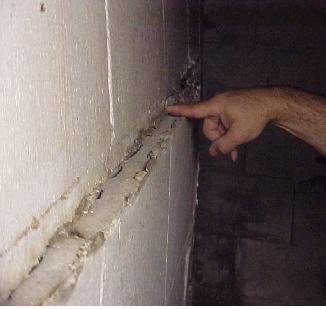
Highly expansive, clay-rich backfill soil caused severe damage to this concrete block basement wall. Sections of the wall were pushed in along joint lines in some areas. Instead of a costly and disruptive wall replacement repair, Woods Basement Systems installed GEO-Lock anchors to stabilize the wall and push the wall back to its original position. The repair is warranted for the life of the structure.
Taking the tilt out of a poured concrete wall
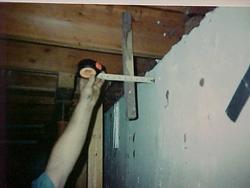
Soil pressure sometimes causes poured concrete walls to tilt inward, as it did at this house in St. Charles, MO. Before the wall anchor repair was made, a wood cleat was fastened to a joist,
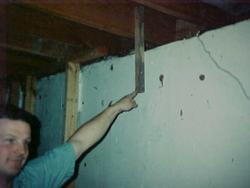
flush with the tilted wall. After installing GEO-Lock wall anchors, Woods technicians were able to pull the wall 3 ½ in. back toward its original position, eliminating the need for total wall replacement.
It’s exciting to see a poured concrete foundation revealed for the first time. The workers strip off the wall forms and you see those massive grey walls standing tall and strong. It’s hard to believe that these same walls might crack, bow and tilt in a few years, forcing homeowners to pay for structural repairs that weren’t anticipated. Experienced foundation repair contractors can help avoid this damage and disappointment by anticipating soil problems that originate during the final phases of house construction.
Imported soil puts foundations under pressure
How does a house built on stable soil succumb to foundation damage because of expansive soil? The answer to this question often traces back to the house construction process. In places such as O'Fallon, Saint Charles, Lake Saint Louis, Saint Peters, and Wentzville in Missouri, soil was removed to create an excavation for the basement. If the excavated soil contained a large number of rocks or tree roots, this material was probably trucked offsite because it wouldn’t be suitable for use as backfill. Later, when the time came to replace soil around the basement walls, new soil had to be brought in from another location. It’s this new soil that has the potential to cause foundation damage.
Clay is the culprit
Fill soil brought in from a different location can have a high clay content. Unlike soil composed of sand and gravel, clay-rich soil doesn’t drain well. Instead, it absorbs water during wet periods and expands in volume. When saturated with water, the expansion of a clay-rich soil can exert as much as 5,500 lbs. per sq. ft. on a house foundation. Such force can push laterally against a foundation wall, causing it to bow or crack. Expansive soil also lifts walls and concrete slabs up, and then shrinks down away from the masonry when the soil dries out. The resulting voids leave slabs, footings and walls unsupported, so this masonry is likely to crack, settle or even break apart in response to swell-and-shrink cycles.
Foundation repairs offer solutions to expansive soil problems
Regardless of when or how a foundation becomes susceptible to expansive soil stress, there are preventative measures that can be taken by an experienced foundation repair specialist. Improving drainage around the foundation is one common preventative measure. In other cases, it may be necessary to reinforce foundation walls to withstand the soil’s expansive force. An third strategy is to replace some of the clay-rich backfill soil with sand and gravel-rich soil that doesn’t expand and contract under different moisture conditions.
Woods Basement Systems is your reputable foundation repair contractor in Missouri. Contact them today with your questions regarding foundation repair in St. Charles and its surrounding areas.