
The Case of the Sinking Sidewalk: A Halloween Mystery Solved by PolyLevel
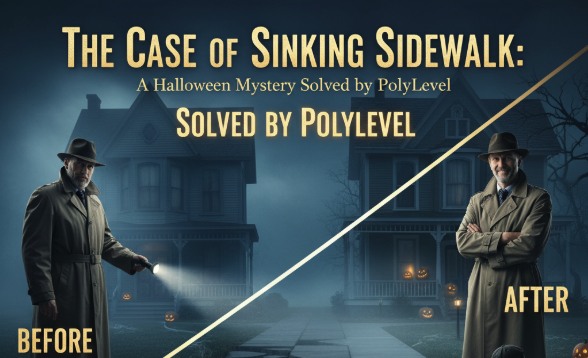
The air grew crisp as Detective Miles "Mac" Concrete surveyed the scene. A once-proud sidewalk, usually bustling with trick-or-treaters, now lay in disarray. Slabs sagged, creating treacherous inclines and sudden drops—a veritable obstacle course under the cloak of twilight. "Another case of the Sinking Sidewalks," Mac murmured, shining his flashlight on a particularly egregious trip hazard near old Mrs. Gable's prized pumpkin patch. Homeowners across town were reporting similar phenomena: driveways resembling roller coasters, patios with unsettling tilts, and pool decks developing mysterious depressions. The culprit was elusive, leaving behind no fingerprints, only the silent, creeping evidence of uneven concrete. This Halloween mystery wasn't about ghosts and goblins; it was about geology and gravity, and Mac knew exactly where to begin his investigation.
Mac’s first step in cracking the case was understanding the "why." His years of experience told him the concrete itself wasn't the primary antagonist. No, the real villain lay beneath, unseen and insidious: the soil. Over time, factors like erosion, compaction, and temperature fluctuations can cause the soil supporting concrete slabs to shrink, wash away, or settle. When this happens, the concrete loses its vital support structure, leading to voids beneath the surface. With nothing to hold it up, the heavy concrete slab inevitably begins to sink, creating the very unevenness that plagued Mrs. Gable’s sidewalk. Traditional "interrogations" of concrete often involved noisy, destructive, and messy methods like mudjacking or, worse, complete slab replacement. But Mac had a new, more refined technique, a high-tech solution that was both elegant and effective—a true marvel of modern concrete forensics.
This is where the hero of our story, PolyLevel, makes its dramatic entrance. Mac, with his team of highly trained technicians, introduced PolyLevel's high-density polyurethane foam into the investigation. Through small, strategically drilled holes in the concrete, the lightweight foam was injected, expanding to fill the hidden voids beneath the slab. As the foam solidified, it gently but powerfully lifted the concrete back to its original, level position. The process was swift, clean, and remarkably quiet—no heavy equipment or noisy jackhammers, just precise, controlled lifting. What was once a perilous path for trick-or-treaters was now a smooth, safe walkway. The Sinking Sidewalk mystery was solved, not with brute force, but with scientific precision. Mrs. Gable's pumpkins looked even brighter against the perfectly leveled concrete, ready for a safe and happy Halloween. The case was closed, leaving behind only the satisfaction of a job well done and a perfectly revived sidewalk, ready for countless future footsteps.
To sign up for a free in home inspection, CLICK HERE.